Outfit Mood Boards That Turn a Pretty Collage Into Real Outfits
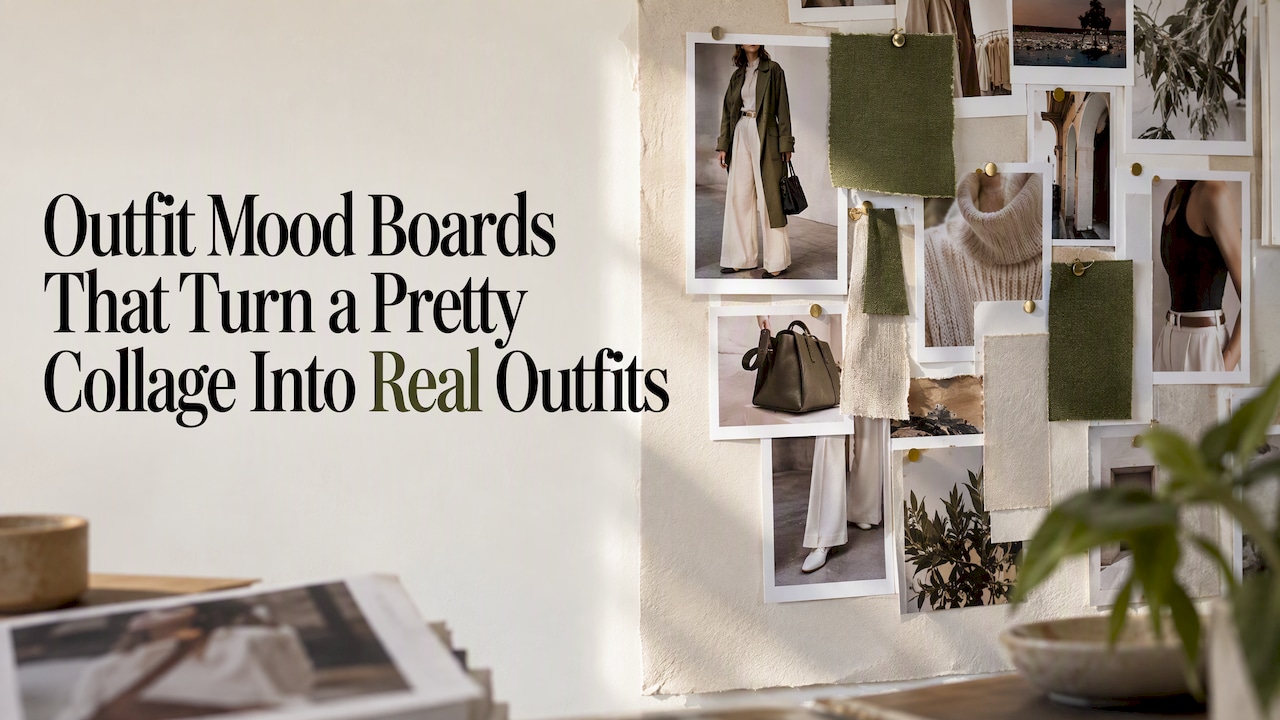
An outfit mood board is a curated visual plan that turns your aesthetic ideas into wearable outfit combos and a targeted shopping list. Done right, it means fewer impulse buys and a clearer sense of what to shop for next. Design fundamentals, practical mood board guidance, and tools like Style To Cart all point the same way: a board only works when it leads somewhere.
TL;DR:
- Build separate boards for work, weekends, or travel, using full outfit photos, lifestyle settings, and owned versus wanted notes to keep each focused.
- Limit each board to about eight core images, then test its combinations in your closet and remove anything that does not work on your body.
- Require each purchase to complete three outfits with owned or planned pieces on your board, and buy first the item that unlocks the most combinations.
- Refresh your board every few months, and trim it when it stops producing outfits; test a small combination before making a larger wardrobe shift.
Table of Contents
- What to put on your outfit mood board
- Step-by-step: build a mood board, physical or digital
- Design elements that make a board wearable
- Turn the board into outfits and a shopping list
- Tools and templates for digital mood boards
- How Style To Cart makes your mood board actionable
- Treat your mood board as a living document
- Organize your finds with Style To Cart
- FAQ
- Sources
What to put on your outfit mood board
A mood board earns its place in your routine when every image on it does a job. Random inspiration photos make a pretty collage, but they do not help you dress. Each item should answer a question: what color, what shape, what fabric, what context.
Build your board around these categories:
- Full outfit photos that show how pieces work together, not just isolated garments.
- Single-item shots of standout pieces, like a jacket cut or a shoe silhouette you want to replicate.
- Color swatches and fabric or texture close-ups that capture the exact tones and surfaces you are drawn to.
- Lifestyle images showing the actual settings you dress for: your office, your gym, a weekend trip.
- Annotations marking what you already own versus what you need, plus quick notes on fit or sizing.
A themed structure helps keep the board focused. A work board might center on tailored shapes and muted color blocks. A weekend board leans into texture and ease. A travel board prioritizes pieces that repeat across several outfit photos, since travel wardrobes depend on versatility more than variety. Separating boards by theme, rather than cramming everything into one giant collage, keeps each one small enough to act on.
Step-by-step: build a mood board, physical or digital
Whether you are cutting pages from magazines or dragging images into an app, the process behind an effective board stays the same. MasterClass’s guidance on fashion mood boards frames it as an iterative tool, not a one-time collage, and that framing changes how you should approach each step.
- Collect widely first. Pull images, swatches, and outfit photos from anywhere that catches your eye, without filtering yet.
- Cluster to find patterns. Group similar colors, silhouettes, or fabrics together and notice what repeats. Recurring elements are the real signal, more useful than any single standout photo.
- Curate down hard. Cut the collection to a small, workable set. Constraint forces decisions instead of leaving everything open-ended.
- Arrange and annotate. Mark which pieces you already own, which you want, and jot quick notes on how specific items pair together.
- Test it against real life. Try the combinations you have sketched out, then update the board based on what actually works on your body and in your closet.
This is where physical and digital boards diverge slightly. A corkboard forces you to commit to prints, which naturally limits the count. A digital board can balloon past the point of usefulness unless you set a cap yourself.
Pro Tip: Cap your board at around eight core images. Past that number, boards stop guiding decisions and start becoming scrapbooks.
Design elements that make a board wearable
Academic design language sounds abstract until you apply it to a photo you are deciding whether to pin. The FIT Museum’s resource on fashion design elements breaks garment design down into line, shape, color, texture, and space, and each one gives you a quick check before you commit an image, or a purchase, to your board.
- Line: does the garment’s seaming or silhouette line lengthen, shorten, or divide the body the way you want?
- Shape: does this piece’s silhouette pair naturally with shapes already on your board, or fight them?
- Color: does the hue, value, and intensity match the palette you have already established, or clash with it?
- Texture: are you mixing textures deliberately, like pairing a smooth fabric with something nubby, rather than by accident?
- Space: does the piece leave room for the rest of an outfit, or does it compete for attention?
Research on design elements for clothing and textiles notes that color carries three dimensions: hue, value, and intensity, and that choosing deliberately across all three affects how appropriate an outfit feels for a given context, from a job interview to a weekend brunch.
Before adding a new piece to your cart, run it through a one-line test: does this match the line, shape, color, texture, or space of at least two outfits already on my board?
Turn the board into outfits and a shopping list
A mood board that never produces an outfit is just decoration. The shift from inspiration to action happens when you start treating the board as a planning document rather than a gallery.
- Mark ownership directly on the board. Use a simple symbol or color code for “own” versus “need” next to every image, so the gap between your closet and your goal is visible at a glance.
- Apply a three-outfit rule. Before adding anything to a shopping list, confirm it completes at least three distinct outfit combinations using pieces you already own or plan to buy.
- Prioritize with a test buy. Pick the single item that unlocks the most combinations and purchase that first, mentally weighing its cost against how often you expect to wear it.
This approach keeps your shopping list short and purposeful instead of a wish list of unrelated pieces. For more on stretching a wardrobe with existing pieces, budget-focused outfit planning covers how to prioritize purchases that work with what you already own.
Tools and templates for digital mood boards
Different tools suit different parts of the process, and picking the wrong one slows you down.
- Template collage editors, like the layouts available through Adobe Express’s mood board templates, work well for arranging images quickly into a clean grid you can share or print.
- Clipping and bookmarking apps are built for speed when you are collecting inspiration from across the web, though they rarely help you test outfit combinations.
- Wardrobe and wishlist apps go further, letting you organize saved pieces, mark what you already own, and plan actual outfits rather than just a visual reference.
Start with a template editor for the collecting phase, then move into a wardrobe app once you are ready to turn images into real combinations and a shopping plan.
How Style To Cart makes your mood board actionable
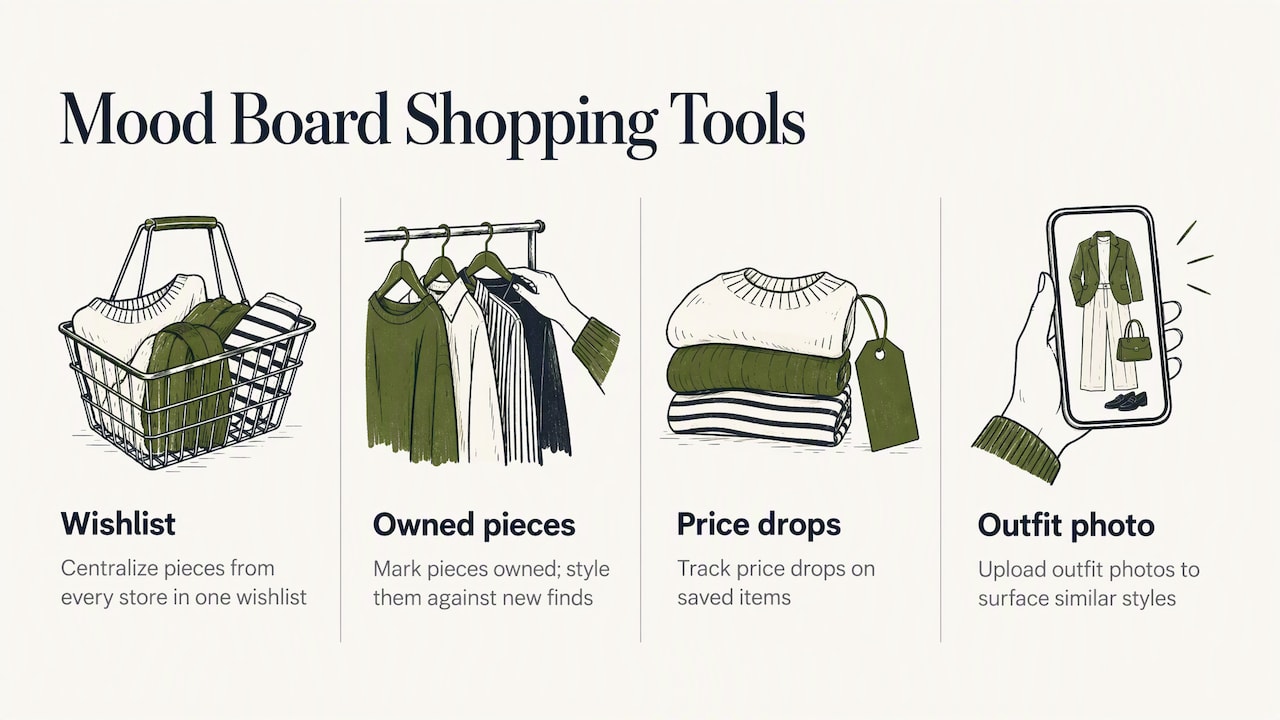
Once your board points to specific pieces, Style To Cart centralizes everything in one wishlist, no matter which store each item came from. We let you mark pieces as owned, style them against new finds, and track price drops on saved items, so your board’s recurring colors and silhouettes can turn into actionable shopping choices. Upload an outfit photo and we help surface similar styles worth adding to your cart.
Treat your mood board as a living document
Mood boards work best as seasonal check-ins, not permanent records. Refresh yours every few months, test a small outfit combo before committing to a full wardrobe shift, and watch for overcollecting, the single most common mistake. When a board stops producing outfits, trim it back down to the pieces that still earn their place.
— Wendy
Organize your finds with Style To Cart
A mood board tells you what to look for. Style To Cart gives you a free place to save it, from any store, in one wishlist you can actually use.
| What you get | How it helps your board |
|---|---|
| One wishlist across stores | Keeps mood board finds in a single place instead of scattered screenshots |
| Price drop tracking | Flags when a saved piece becomes worth buying |
| Photo-based style discovery | Turns an outfit photo into similar items you can shop |
Start building your wishlist at Styletocart.
FAQ
What goes into a mood board?
An outfit mood board should include full outfit photos, single-item shots, color swatches, fabric or texture close-ups, and lifestyle images showing where you plan to wear each look. Annotations marking owned versus wanted pieces help turn the collection into a usable plan rather than a scrapbook.
What is the 3-3-3 rule for fashion?
There is no single standardized “3-3-3 rule” documented in fashion design references, and definitions vary across sources. A common informal version suggests building outfits from three tops, three bottoms, and three pairs of shoes to maximize combinations, similar in spirit to the three-outfit rule used when deciding whether a new piece is worth buying.
What are the 7 elements of fashion design?
Design references typically describe five core elements: line, shape or form, color, texture, and space, as outlined in FIT Museum’s resource on fashion design. Some sources add related concepts, which is why counts vary between five and seven depending on the source.
What are some good themes for a fashion show?
Fashion-show themes typically center on a single mood, era, or concept, like minimalism, a specific decade, or a cultural celebration, so that every look reinforces one idea. For everyday mood boards, the same logic applies on a smaller scale: a work theme, a weekend theme, or a travel theme, like the examples in Left for Left’s Pride outfit ideas, keeps the board focused on wearable, cohesive looks.
Can Style To Cart help me shop from my mood board?
Yes. Style To Cart lets you save pieces from any store into one wishlist, mark what you already own, and get alerted to price drops on anything tied to your board’s style direction.
Sources
- How to Create a Fashion Mood Board - MasterClass
- Elements and principles of fashion design - FIT Museum resource
- Elements of design for clothing and textiles - Utah State University Extension