
Cost Per Wear: When $90 Boots Beat a $30 Top
Cost per wear is the price of an item divided by the number of times you expect to wear it, and it’s one of the fastest ways to compare clothing purchases on real value instead of sticker price. It works well for staples you’ll wear often, like jeans or a work blazer, but it tells you almost nothing about a wedding gown or a one-off holiday outfit. Below, we break down the formula, run through worked examples, and show where the math falls apart.
TL;DR:
- Include tax, expected repairs, and cleaning in the price, then estimate conservative, moderate, and optimistic wears; cut optimistic guesses by about one third.
- Under $1 per wear suits frequently used basics; $1 to $5 fits many staples, while $5 to $20 can suit regularly worn investment pieces.
- Skip CPW for one off occasions: a $350 dress worn twice costs $175 per wear, but that figure alone cannot judge an event driven purchase.
- Research found that CPW comparisons favor higher quality clothing when shoppers see figures side by side and independent durability certification, not merely a brand’s claim.
- Twice yearly, rank items within three to five frequently worn categories; repair costly pieces you still choose, and consider resale for expensive items rarely worn.
Table of Contents
- What cost per wear actually means
- How to calculate cost per wear step by step
- Benchmarks: how to interpret your cost per wear
- Where cost per wear misleads you
- Running a wardrobe audit with cost per wear
- How Style To Cart makes cost per wear tracking practical
- When I use cost per wear and my rules of thumb
- Track your wears and recalculate with Style To Cart
- FAQ
- Sources
What cost per wear actually means
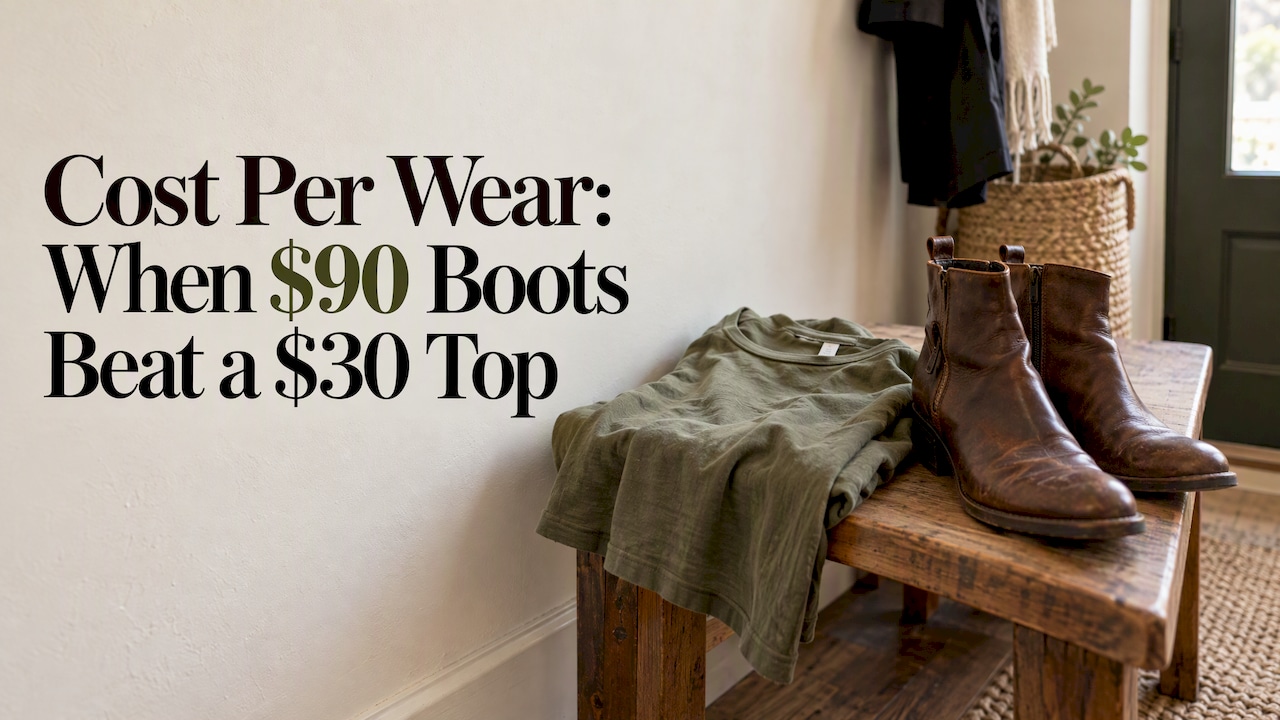
Cost per wear, often shortened to CPW, is a simple ratio: the price you paid divided by the number of times you wear the item. A $90 pair of boots worn 60 times costs $1.50 per wear. A $30 top worn twice costs $15 per wear. The number flips the usual logic of shopping: the sticker price stops being the main signal, and how often you’ll actually use something takes over.
The basic formula has three parts worth separating:
- Purchase price: what you paid, including tax, but you can also fold in alterations or care costs for a fuller picture.
- Expected wears: an estimate based on how often you’d realistically wear the item in a season or year.
- Realized wears: the actual count once you’ve owned the piece for a while, which almost always differs from your first guess.
That gap between expected and realized wears matters more than most people assume. Research testing how people respond to CPW information found that communicating cost per wear shifts consumer preference toward higher-quality clothing, but mainly when the comparison is visible and the durability behind it can be verified. In other words, CPW works as a kind of unit price, similar to cost per ounce at the grocery store, but only when you have something real to compare it against. A single CPW number sitting alone on a price tag does not move behavior nearly as much as two numbers side by side.
How to calculate cost per wear step by step
The math itself takes seconds. The harder part is being honest about how many times you’ll actually wear something, which is why a structured method beats a gut guess.
- Record the full price, including tax and any repairs or cleaning you expect to pay for over the item’s life.
- Estimate expected wears using a conservative, moderate, or optimistic scenario rather than one guess.
- Divide price by wears, then round to the nearest cent for everyday comparisons.
For step two, it helps to run three scenarios instead of picking a single number out of the air:
- Conservative: assume you wear it less than you think, useful for anything trendy or seasonal.
- Moderate: based on how often similar pieces in your closet actually get worn.
- Optimistic: your best-case scenario, useful mainly as an upper bound.
Here’s how that plays out with three common purchases.
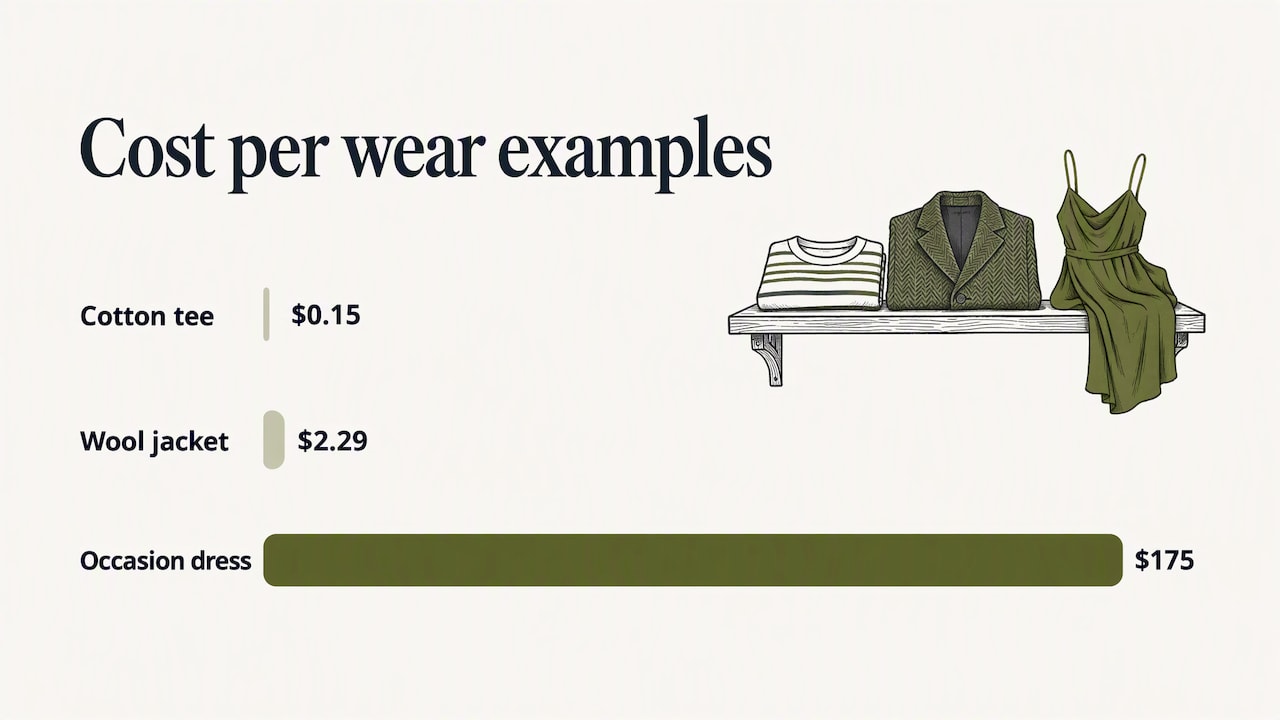
Example 1: the $15 cotton tee. You buy a basic tee for $15 and wear it roughly once a week for two years, about 100 wears. CPW is $15 ÷ 100 = $0.15 per wear. Cheap and low risk, even if it falls apart after a year.
Example 2: the $220 wool jacket. A midweight jacket costs $220. Worn twice a week through four cold months a year, that’s about 32 wears a year. Over three years, that’s 96 wears, giving a CPW of $220 ÷ 96 = roughly $2.29. The jacket costs more upfront but lands in a very reasonable range once you spread it out.
Example 3: the $350 occasion dress. You buy a $350 dress for one wedding and maybe one holiday party, two wears total. CPW is $350 ÷ 2 = $175 per wear. The math isn’t wrong, it’s just the wrong tool for a purchase driven by occasion rather than rotation.
A quick calculator for this needs only four inputs: purchase price, expected years of use, wears per year, and any extra costs like dry cleaning or repairs. Plug those in and you get a number you can compare across your closet in minutes, which is the entire point of the exercise.
Benchmarks: how to interpret your cost per wear
A CPW number means little without context, so it helps to think in bands rather than exact figures.
- Under $1 per wear: typically basics worn constantly, like t-shirts, underwear, or gym leggings. This range signals excellent value regardless of the original price.
- $1 to $5 per wear: a common zone for mid-weight staples such as jeans, sweaters, and everyday shoes bought with reasonable care.
- $5 to $20 per wear: often investment pieces like a tailored coat or quality boots, reasonable if the item gets steady rotation over several years.
- Over $20 per wear: usually a sign the item is either rarely worn, a special-occasion piece, or simply overpriced for how it’s used.
These bands shift depending on category and context. A $20 CPW on a wedding dress is unremarkable. The same number on a t-shirt means something has gone wrong, either the price was too high or the shirt barely left the closet. Replacement cost matters too: an item that’s expensive to replace, like a well-fitted coat, can justify a higher CPW if it would be costly or time-consuming to find an equivalent.
One number worth remembering: communicating CPW increases preference for higher-quality clothing specifically when the comparison is paired with independent certification, which means a durability claim backed by actual testing carries more weight than a brand’s own promise. That’s worth watching for on care labels and product pages when you’re deciding between two similarly priced options.
Where cost per wear misleads you
CPW is a useful lens, not a universal rule, and it breaks down in a few predictable ways.
- Special-occasion items: a dress worn once for a wedding will always have a high CPW, and that’s not a reason to skip the purchase.
- Optimism bias: most people overestimate how often they’ll wear something new, especially trend pieces bought with good intentions.
- Opportunity-cost thinking: when people are focused on finding meaning in a purchase, they often gravitate toward less expensive options even when the pricier item has a lower cost per wear, which shows CPW competes with other, less rational motivations.
- Isolated numbers: a single CPW figure with nothing to compare it to rarely changes a purchase decision on its own.
Fashion coverage of the metric makes a similar point: CPW works best as a decision aid for wardrobe staples and struggles as a tool for anything bought primarily for novelty or a single event. Treat your wear estimates the same way a cautious lender treats income projections: lower than your gut says, and revisited once you have real data.
Pro Tip: When estimating wears for anything new, cut your first guess by about a third. Most closets have more “I’ll wear this all the time” purchases gathering dust than anyone likes to admit.
Running a wardrobe audit with cost per wear
A mini-audit across a handful of items turns CPW from a one-off calculation into an ongoing habit.
- Pick 3 to 5 categories you wear often, such as jeans, outerwear, work shoes, or everyday bags.
- Pull the price and estimated wears for each item, using receipts or your best recollection.
- Calculate CPW for each piece, rounding to the nearest cent.
- Rank the results from lowest to highest CPW within each category.
- Flag outliers at the high end for repair, resale, or replacement.
Once you have the rankings, decisions tend to sort themselves. An item with a high CPW that still fits well and gets compliments might be worth repairing rather than replacing. One that’s expensive per wear and rarely chosen is a strong candidate for resale, freeing up both closet space and a bit of cash toward something you’ll actually use.
A short shopping checklist helps apply the same thinking before you buy, not just after:
- Fit first: a lower CPW item that doesn’t fit well will still sit unworn.
- Versatility check: does it pair with at least three things you already own?
- Identity match: does it match how you actually dress, not how you wish you dressed?
Running this process twice a year, once at the start of each season, keeps the data current and keeps CPW grounded in what you’re really wearing rather than what you intended to wear. For a deeper framework on prioritizing pieces during an audit, our guide to building a closet you actually wear walks through the same logic in more detail.
How Style To Cart makes cost per wear tracking practical
Most of the error in CPW calculations comes from guessing, not math, which is exactly where a wardrobe tool earns its place. With Style To Cart, we let you save items from any store into one wishlist instead of scattering them across screenshots and notes, which makes it far easier to compare price and projected use before you buy rather than after.
Once something is saved, you can build outfits with pieces already in your closet, so you can see at a glance how often a new piece would realistically get worn alongside what you own. That single step cuts a lot of the optimism bias that inflates wear estimates in the first place.
A few habits make the difference:
- Save before you buy so price and fit decisions happen with less pressure.
- Revisit saved items periodically to update your wear expectations with real data.
- Use price-drop alerts to catch a lower cost basis on something you’ve been tracking, which improves CPW without changing how often you wear it.
For more on pairing this with a budgeting mindset, see our notes on planning outfits around what you already own, and for examples of pieces worth repeat investment, our stylist notes on the pieces we buy again offer a useful starting point.
When I use cost per wear and my rules of thumb
I reach for CPW constantly on staples: jeans, coats, shoes, anything that’s going into weekly rotation. I track actual wears for about a season before I trust the number, because first guesses are almost always too generous. For anything tied to a single event, a holiday party dress, a costume, a once-a-year occasion, I skip the metric entirely and judge the purchase on its own terms.
My rules of thumb are simple: estimate conservatively, recalculate after six months with real wear counts, and never let a low CPW override a bad fit. A great price per wear on something that doesn’t flatter you or match how you actually dress is still a loss.
— Wendy
Track your wears and recalculate with Style To Cart
Running the math in this guide gets easier once your wishlist, outfits, and prices live in one place instead of scattered across camera rolls. With Style To Cart, we help you save pieces from any store, build outfits with what you already own, and catch price drops automatically, which keeps your cost-per-wear estimates grounded in real numbers instead of guesswork.

Ready to see your wardrobe differently? Start with Style To Cart and bring some structure to the next purchase you’re weighing.
FAQ
What does “cost per wear” mean?
Cost per wear is the price of an item divided by the number of times you wear it, giving you a per-use cost instead of a sticker price. It’s a way to judge long-term value, especially useful for comparing a cheaper item you’ll replace often against a pricier one built to last.
How do you calculate cost per wear?
Divide the total purchase price, including any repairs or cleaning, by your estimated number of wears over the item’s life. A $90 pair of boots worn 60 times works out to $1.50 per wear, while a $350 dress worn twice comes to $175 per wear.
What makes a woman look wealthy?
Fit and condition tend to read as more polished than brand names or price tags, since well-maintained, well-fitted clothing signals care regardless of cost. Choosing a small number of versatile, durable pieces over frequent low-cost purchases often achieves this look while keeping cost per wear low.
Is $500 a lot to spend on clothes?
It depends entirely on what the item is and how often you’ll wear it, since cost per wear matters more than the sticker price. High-quality staples worn regularly can have a low cost per wear, while items bought for a single occasion stay expensive no matter how you calculate it.
Sources
- Shifting Toward Quality: How Communicating “Cost per Wear” Influences Consumer Preference for Clothing
- Cost per wear: How this economic indicator could finally counter ultra-fast fashion
- Pursuit of Meaning and the Preference for Less Expensive Options | Journal of Consumer Research